Watch on Youtube: https://www.youtube.com/@chargethewave
Follow & Subscribe to Charge the Wave: Spotify, Apple
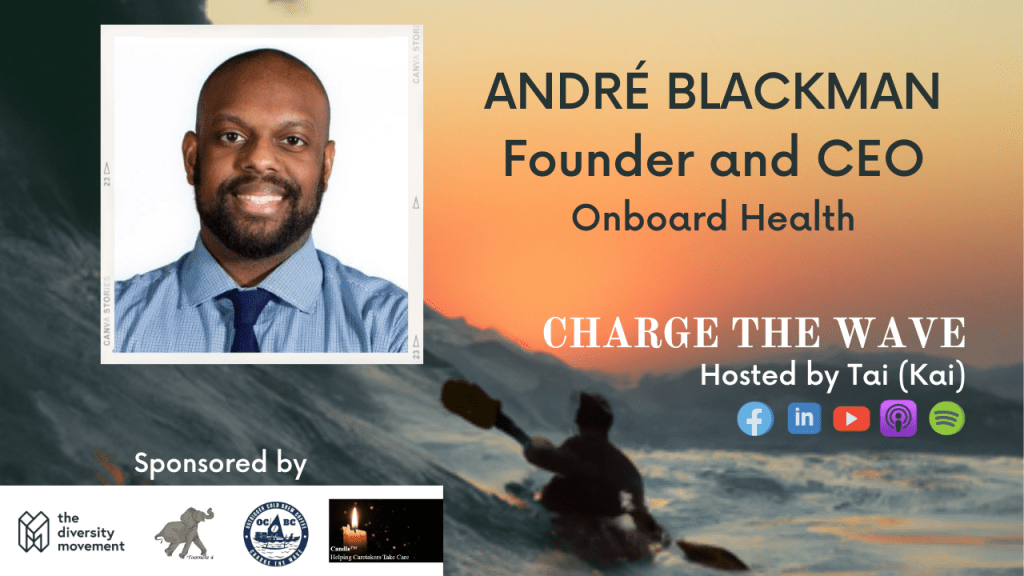
In this episode of Charge the Wave, we welcome guest André Blackman, the Founder and CEO of Onboard Health, a specialized executive search and advisory firm focused on creating a more inclusive future of health. Andre is a pioneer with deep ties across healthcare innovation & startup worlds. His insights have been featured in Fortune, Forbes, NPR & more.
Tune in to this episode as André shares insights into:
- How he began blogging and sharing his ideas for the future of health
- What led him to launch Onboard Health
- Books that have helped him along his journey
- Tools that he uses to avoid mental burnout
About André Blackman
André Blackman is the Founder and CEO of Onboard Health, a specialized executive search and advisory firm focused on creating a more inclusive future of health.
A pioneering strategist with deep ties across the healthcare innovation, startup and digital strategy landscapes — André is dedicated to building the future of health through an equity lens.
His work and insights have been featured in Business Insider, Fortune, Forbes, NPR, CIO, Reporting on Health, U.S. News and World Report. He was recently named a Fortune Magazine 2020 40 Under 40 in Healthcare.
Learn more about André Blackman:
Visit André’s personal website: http://andreblackman.com/
Visit André’s business website: https://www.onboardhealth.co/
Connect with André on LinkedIn: https://www.linkedin.com/in/andreblackman/
Follow André on Twitter: https://twitter.com/mindofandre
Read the full transcript of this episode:
TAI ( 00:02:21) Today’s guest is Andrè Blackman, Founder of Onboard Health, a specialized executive search and talent advisory firm dedicated to building an equitable future of health. Andrè is a pioneering strategist with deep ties into the public health, social innovation and strategic communication landscapes. He’s dedicated to building the future of health through an inclusive lens. Andre is a sought after adviser to companies building the future of health and Brand Builder for the leaders who run them. His work and insights have been featured in CIO, Fortune, Forbes, NPR, Reporting On Health and US News and World Report. Without further ado, let’s jump right in.
Hello, hello, everybody. Welcome to Charge the Wave. Today’s guest is Andrè Blackman, founder of onboard health. And we’re gonna go ahead and jump right in. Andrè, congratulations on all your success with Onboard Health which we’ll get to for sure. But I wanted to start where it all began. And just hear a little bit about where you grew up and your childhood.
ANDRÉ ( 00:03:24) Fantastic. Super happy to be here guy, thank you so much. So you know really grew up in the Silver Spring, Maryland area in the in the DMV, the DC Maryland area, the DC, Maryland Virginia area. And you know, from there was was definitely a super nerd. My mom, you know, made sure I had all the access to the chemistry sets and biology sets. So science was definitely my thing. It just kind of grew up in that area, was really focused on how things worked. And so, you know, over the over the years, some of my childhood really got focused on building things and exploring how things were put together. And that led me into, you know, things like high school programs, working at Walter Reed, and, you know, helping me to be part of a summer program where we got to kind of go to different places in the area and learn how things work. So, you know, high school was NASA and Walter Reed and all that kind of good stuff too. And so it was a fun childhood.
TAI ( 00:04:31) Did you have any siblings?
ANDRÉ ( 00:04:33) Yes. So I have an older sister and a younger brother Avian and Mike and so they are geniuses in their own rights, Avian around food, Mike around kind of sports and drink and now you know he’s this kind of expert level mixologist in the DC area where you can find a lot of his drinks on the menu in the downtown DC restaurants. You know and my sister also highly accomplished executive chef who has served people like Tiger Woods, as well. So I’m surrounded by by greatness for sure.
TAI ( 00:05:12) Any unique or interesting challenges or experiences that you can recall from your childhood?
ANDRÉ ( 00:05:19) Oh, wow. Don’t we all, right? I would say that, you know, for me, there was this, you know, mantle of, you know, being quote unquote, advanced, right, or needing to continue doing amazing things. And, you know, as a child, you know, you’re trying to explore, you’re trying to, you know, figure yourself out, especially in relation to your peers. And for me, I think one of the greatest challenges was kind of balancing, you know, having fun with, you know, opportunities to do amazing things, right. Like I said, you know, as soon as I could, right, I had my, at 15 years and nine months, I had my workers permit, right, um, and being able to, you know, actually hold down jobs and things of that nature, too. So, I would say balancing, you know, trying to be a kid, while also having this mantle to constantly be pursuing, you know, just kind of extraordinary things, which, you know, I definitely don’t regret. But now, as a dad, I also have a different perspective on childhood and what you, you know, can allow your child to do to be themselves.
TAI ( 00:06:32) Any specific mentors or role models you’d like to give a shout out to?
ANDRÉ ( 00:06:38) Oh, yeah, absolutely. One of the mentors that really stands out in my head is Dr. Michael Muma, who was an astrophysicist. So in my senior year in high school, I did an internship at NASA Goddard, in Greenbelt, Maryland, and got to work in the astrophysics department, where we did some research around like the Hale-Bopp comet, and things of that nature too. And apart from just like the sciency stuff, Dr. Muma, really showed me in opportunities around work ethic, and not being so hard on myself when things don’t go the way that I had planned them to go. And, you know, he had so many different space related anecdotes, like, you know, nothing goes the way that you plan when you’re out in space, and that sort of thing, too. And so, you know, he was definitely one of the mentors for me, and then also, George Kettle, he was a man who brought Century 21 Real Estate over to the East Coast, you know, super accomplished in his own right. But was also able to, really kind of helped me understand, you know, aspects of like philanthropy, and how to network properly and always have a story to tell is one of the things that he helped me to always keep with me.
TAI ( 00:08:06) Thanks for sharing that. That’s really neat. I think I know, but can you tell us how you chose the University of Maryland?
ANDRÉ ( 00:08:15) Yeah, I mean, you know, hometown, you know, state school. But, you know, once again, I was really enamored with space and flight. And so I went to Maryland, which had a great program around aerospace engineering. And so coming from NASA, and being able to like go to the aerospace engineering program at University of Maryland. That was, that was my way in there. And so that’s one of the reasons why I chose that obviously, you know, proximity, I was able to stay home. So some students that I that I had some friends that I went to high school with, we all kind of went over to Maryland as well.
TAI ( 00:08:52) We’ll transition to the career component of the episode, Reid Hoffman has a book, The Startup of You, talking about treating your career as a living, breathing, growing startup. When you graduated University of Maryland, how did you think about your career? And can you share with us a little bit about your journey and stops along the way?
ANDRÉ ( 00:09:14) Absolutely. That’s a great book, by the way. I would say that kind of leaving school, I had switched my majors to public and community health. And so I was definitely seeing my career, you know, focus on disease prevention. I really wanted to find ways that prevented large groups of people from having disease, from being sick. And this is where a lot of like my social impact community was being built. And so I saw my career as being deeply connected to social good, and impact and community building. And so you know, how that looked around, you know, jobs or roles that I took, you know, was one thing and I never really thought that I would, you know, move into the entrepreneurial game. And I think like, you know, just kind of noting one of those stops along the way that really helped me to do that was when I started writing the Pulse+Signal Blog in 2007. This was when social media was just getting hot. I think that was also the year that Twitter launched, and I was there. So one of the first people that was kind of on the Twitter platform, but you know, writing Pulse+Signal allowed me to reach people literally around the world. And that was a pretty significant milestone in my career, where I was able to share ideas that I had about the future of health. But one of the things I really enjoyed doing was finding people and talking to them about their own journey, and stories. And that’s what really helped me to launch a platform was writing about people, interviewing them. And that’s what really kind of, you know, moved me into kind of the social space, I had my flip video camera, I’m not sure if, if you remember that, right, like the portable camera. And I took that to conferences, this is when you know, the Health 2.0 conference really got started. And I was the guy out there with my flip video camera interviewing people like Susannah Fox, who at that point was at the Pew Internet Project and leading a lot of their health initiatives as well. And so that was a really, you know, significant part of my career is connecting with people. And you know, being able to like, you know, be the storytelling guy. And then I would say, like, the next significant part was being able to, you know, go and lead digital at the American Heart Association, you know, from their mid atlantic affiliate, and then being able to work with affiliates across the country, the national office, on various campaigns around CPR, and things of that nature to and really being able to see a lot of the impact that the American Heart Association had. You know, one of the, I guess, you know, other kind of key moments was joining together with my friends, Aman Bhandari, and David Haddad to create the Fast Forward Health Film Festival in 2011. And I’m sorry, you can see the storytelling narrative. That’s that’s the thread through here. But we co-created that event. And we’re able to take that across the country in a number of different places, and really enjoy that. And then finally, I would say, like a really big milestone in my career is going back to my alma mater at the University of Maryland in 2016. And giving the commencement address for the spring, outgoing class, and that was such a rush to be on stage, but also to speak into the lives of the outgoing class around their life and their career as well.
TAI ( 00:12:51) What led you to becoming an entrepreneur and then starting and founding Onboard Health?
ANDRÉ ( 00:12:59) Yeah, that’s a great question. You know, prior to starting Onboard Health, I had a consultancy, which was called Pulse+Signal, the name of the blog where I did digital strategy work for a number of digital health startups and healthcare organizations. So there was a little bit of that kind of consulting, you know, entrepreneurship kind of piece. Ligeia Ricciardi gave me my first opportunity to do consulting, she was one of the directors over at ONC, the Office of the National Coordinator. And so that was, you know, that got my feet wet in kind of the entrepreneurial landscape. But after I did the commencement address, and 2016, and went to the Aspen Ideas Festival, that same year, I really had this bug in the back of my head around what the future of health was going to look like, and how it was being built through the workforce. And so I really had this fire in my belly around building a more diverse and inclusive workforce ecosystem to tackle the kind of issues that we were seeing, especially around things like the social determinants of health. And so that’s when Onboard Health really got started, is that how do we really create a workforce that is representative of our society, and the individuals who have the backgrounds and skill sets to build this kind of modern and equitable future of health. And so that’s how Onboard Health got started, is really kind of building an ecosystem and a network and a community of individuals who had those skill sets. And then, you know, helping organizations with, you know, executive search and advisory services.
TAI ( 00:14:46) Are there any founders or execs that you’ve spoken to recently that you’d like to give a shout out to in terms of placements or clients that you’re working with?
ANDRÉ ( 00:14:57) Oh, absolutely. There’s quite a bit. So definitely have to shout out and executive Dr. Ivor Horn who’s leading health equity at Google now. You know, she has not only shaped my career, but also has helped to just kind of, you know, create that pathway for not only myself, but a number of entrepreneurs and founders in the space of creating a more equitable future of health. Founders, like Ashlee Wisdom of Health in Her HUE, and Iyliese Andino, Andrew Schultz, of LifeShare Health, just an incredible story of, you know, kind of starting out into barber shops to create literacy moments for individuals around their health, and now scaling that, you know, across health care. And so, you know, would also love to shout out individuals and leaders like Sarah Rodarte, who’s over at Verily now, who’s leading a lot of their communications and content. And, and Dr. Vindell Washington also at Verily, We partnered up with them last year, to convene a dinner with health equity leaders. And it was one of the most powerful things that I’ve done in my career so far, just in partnership with them. Sarah has a tremendous kind of eye towards storytelling and convening individuals, and Dr. Vindell, Washington, you know, over a fairly, who has just as a tremendous humble executive, and leader, and has a heart for seeing real change. And so I’d love to shout those individuals out.
TAI ( 00:16:44) That’s incredible. Anything you wish you knew, when you began your founders voyage?
ANDRÉ ( 00:16:54) Everything right, I would say that things take more time than you think, a lot more time than you think. And, you know, I think that would, you know, I think you have to just be in there and learn that through doing. And then also, you know, just the, the incredible power of taking action, and being decisive, this is something I’m still, you know, working on as well. But you know, making a decision and moving through it. Speed and action is definitely one of those things that are important to an entrepreneur and anybody who’s creating something of value.
TAI ( 00:17:33) What would you consider a success over the next year for Onboard Health?
ANDRÉ ( 00:17:39) Yeah, I would say that, you know, with onboard health, you know, being able to continue to place just, you know, incredible individuals, at companies that are doing great work. I think, you know, where we’re seeing a lot of, of impact, especially around the behavioral mental health space, we’ve had, you know, tremendous opportunity to work with companies like big health, you know, in the mental health space, and being able to provide them with support around, you know, the leaders that are looking at things like, you know, health equity and population health, you know, tremendous companies like Mahmee out in Los Angeles, that’s, that’s being led by Melissa Hanna that’s transforming maternal health, you know, Axis as well, as well, some companies that we’re working on right now. So I would say like success is continuing to help to build the leadership teams that these companies so that they can, you know, in turn to do continue doing incredible work. And also, once again, continue to support the community that we’re building of founders and leaders, so that they can feel seen and show up authentically and continue to create the impact that they’re, that they’re working on doing.
TAI ( 00:18:59) And what that will take a beat for a message from our sponsors. And we’ll return momentarily and close out the show.
VOICEOVER ( 00:19:07): Charge the Wave is brought to you by The Diversity Movement. The Diversity Movement DEI Navigator is everything you need all in one place. You get access to a host of resources with DEI Navigator and all at a fraction of the cost of hiring a full service DEI consultancy. Visit http://www.thediversitymovement.com/footnote to learn more. Outrigger Cold Brew Coffee Co. Be wherever you may and whatever your next challenge. Outrigger Cold Brew Coffee company is cold brewing our next batch of Aloha spirit from soil to sip to help you charge the wave.
TAI ( 00:19:48) Welcome back, everybody. Now we are on to the advice section and let me kick it off with, is there a book that you would recommend to our audience for them to level up over the next few years?
ANDRÉ ( 00:20:05) I love books, Tai, like thank you so much for that question. I would say one of the books that I would recommend, that I recommend to some of the mentees, I have a group of mentees, early career professionals that I’m just excited to be working with. And like, one of the books is Mindset by Carol Dweck. The book really kind of, you know, looks at kind of growth mindset. And, you know, just kind of thinking about, you know, ways in which like, you are able to rise to the occasion for challenges that, that come to you. So, you know, kind of looking at, like fixed mindset versus growth, like fixed, really kind of, you know, lends itself to thinking that, like, you only need like, have like a certain set of skill sets or knowledge that you can apply to anything. And if you don’t have it, you can’t succeed. Growth mindset really has a lot to do with like figuring it out. And I really enjoy that whole concept. So I would definitely say mindset. And then if I can add another one, really quickly, Essentialism (by Greg McKeown) is another book that I would definitely offer as another great one, to level up.
TAI ( 00:21:23) And speaking of leveling up, is there one piece of advice you’d have for someone trying to apply or land that next executive role or new opportunity?
ANDRÉ ( 00:21:38) Yeah, I mean, one piece of advice, and you know, I’m very narrative and story driven. So obviously, you know, dotting all your your I’s and crossing your T’s on, you know, creating a compelling body of work and making sure that that translates well into whatever kind of, you know, document that you’re, that you’re sharing. But I would also say like having a story to tell with your own self, about what you’ve done, and where your vision of impact in contribution wants to go. I think oftentimes, like in the career landscape, we’ve been really conditioned to just kind of look at things in a very kind of quantitative, you know, perspective, which is all, you know, still very great. But one of the things that I encourage, especially leaders is to have a have a narrative around the impact that you’ve created, and what you want to continue creating an impact around. And that will help to guide some of the conversations that you have, you know, with the job search, but also you having a perspective on yourself on what is going to align with where you want to give your time, from a career perspective. So having that kind of narrative for yourself, not only with what you’ve done, but where you want to go, I think is incredibly important.
TAI ( 00:22:59) Having placed a few key hires, or executives over the last several quarters, have you noticed any common denominators or traits from some of the most successful executives you’ve worked with? Or companies?
ANDRÉ ( 00:23:14) Yeah, I would say one of the, one of the key kind of themes I’ve seen is the willingness to make kind of adjustments to your, to how you want to reinvent yourself. Oftentimes, you know, when when kind of leaders are looking to kind of make moves, especially whether that’s, you know, from a large corporate, you know, environment to maybe like a flourishing startup is to make adjustments to how you see yourself, and being willing to try new things still is kind of the ask that I’ve seen, you know, just kind of being open to trying new things. And having that story, once again, really helps to guide some of those kind of powerful successful placements that we’ve seen.
TAI ( 00:24:18) Great. And you and I have talked about burnout before. And I’ve advised, you know, over the last decade, and burnout seems to become a bigger, bigger issue, especially during this pandemic, for whatever reason. Is there certain tools and methods frameworks you use to manage your mental health and energy runway?
ANDRÉ ( 00:24:44) That’s a great, that’s a great point there and I think a lot of us are still kind of managing that and trying to figure that out. I love talking about this because, you know, from a tactical perspective, moving your body has been something that has been really important and helpful for me, whether that’s, you know, kind of getting some, some yoga time in there, going to the gym, going out for a walk with no music in your ear, you know, being present. That’s one of those kinds of things where I think a lot of us have been conditioned to constantly just be going, going and going. And so what happens is that we detach and disconnect from our bodies and how we’re feeling where I feel like that’s a really big aspect of burnout is that, you know, you’re up here a lot, and you’re like, hey, I got to keep doing this, I got to keep going. Your body is probably giving you a lot of signs, like, Hey, this is not working right now. And we’ve been trained to over caffeinate, you know, stay scrolling on our devices. And that pushes that kind of awareness about our bodies further and further away. And so reconnecting with our bodies around like activity, exercise, that sort of thing too, you know, it’s been, has been huge. And then also really taking a step back. And I think this is one of the things that I’ve seen, come out of the pandemic is really assessing your life, and what kind of buckets that you’re putting your energy into. Making sure that you have a support system, that you especially if you’re looking at it from a work perspective, work is not life. I know, that’s typically hard, especially like as an entrepreneur founder. But it’s absolutely essential that you break up time with, you know, spending time with your friends, you know, finding, you know, hobbies, like painting or something like that, too, as you can, as well to just kind of really diffuse a lot of that pressure to keep going. So those are a couple different thoughts there too. Oftentimes, you know, easier said than done. But we absolutely have to prioritize, you know, our health and our mental health these days.
TAI ( 00:26:54) And before we jump to the lightning round, what, what’s the next wave for you to charge? In other words, what’s next for you? And Onboard Health?
ANDRÉ ( 00:27:04) Yeah, I mean, I think with with us at Onboard Health, you know, really making sure that we’re connecting with the right companies that see the value in creating a more equitable future of health. You know, there’s been a lot of things that have happened around social injustice, racism, health equity, especially with the last few years, there’s been a lot of mandates, a lot of promises, things of that nature too around, you know, kind of creating, you know, more diversity into our companies and things of that nature, too. And what I’ve been seeing is, you know, it’s a lot more powerful, to, at least for us to do more of the action-oriented building versus convincing. And so that’s another area that that’s kind of next on the frontier is making sure that we’re, you know, working alongside of organizations that, more or less are ready to get to the doing part, versus the convincing piece. And then really, you know, continuing to equip our community of changemakers and leaders to continue supporting them, whether that’s through the convenings and the programming and things of that nature, too. And so and personally for myself, the mentorship for you know, early and emerging professionals to just continue to helping them accelerate their careers, but of aligning their lives as well. So that’s the next wave that I’m really excited to charge.
TAI ( 00:28:32) Thank you so much for sharing that. And with that, we’ll move to the thunder and lightning round. You mentioned over caffeinated. I am definitely an over caffeinator. My favorite caffeine is Outrigger Cold Brew coffee from Hawaii. What was your caffeine of choice?
ANDRÉ ( 00:28:49) I love it. And I need to try some of that for sure. I’ve really been enjoying black and bold they are a black owned coffee business. So BLK is how they spell black. And a portion of the proceeds goes to building kind of, you know, you know, city wide initiatives as well. And so I love that kind of like social impact aspect to it and how they’ve just been doing an incredible job there. They obviously they have great coffee as well. And Couplet Coffee is another great one as well. That I would definitely recommend.
TAI ( 00:29:31) What’s your favorite local restaurant?
ANDRÉ ( 00:29:34) Ooh, favorite local restaurants. Centro, down in downtown Raleigh, they are authentic kind of Mexican food with just top tier Mezcal offerings as well. So I’m a big like tequila fan. And but the food is absolutely incredible. So I would definitely say like Centro is a fantastic local restaurant.
TAI ( 00:30:01) I’ll have to try it next time I’m in the Triangle. Any favorite hobbies when you’re not, you know, rising and grinding?
ANDRÉ ( 00:30:11) Right, I would say I recently got into boxing. And it’s been a tremendous way for me to, you know, get a workout in, but also, you know, once again, to be in my body and to ground myself with some sweat, some movement, terrific community as well. And so that’s been something and then I’ve gotten back into writing. And so I’ve really, and I might as well you know, be set up some accountability for myself, but I’m starting to write this like, sci fi, kind of space noir detective mystery. And so I’m really excited about that, think about like, you know, old school like 30s, you know, detective and just kind of this expansive kind of mystery to unravel. So, I’m getting into some creative writing now. So that’s been great too.
TAI ( 00:31:09) Favorite favorite sports team, musical or show?
ANDRÉ ( 00:31:15) That’s that’s the tough one. I would say that. I really enjoy the show Lost when it came out. Um, a lot of people are have mixed feelings about it, but I was a big fan. And currently I’ve just been really getting involved in some of the Star Trek spinoff shows. And like Star Trek Picard I’ve really been enjoying watching that show as well.
TAI ( 00:31:39) Favorite vacation spot?
ANDRÉ ( 00:31:43) Wow. favorite vacation spot? I would say Kauai ironically enough, one of the most magical places I’ve ever been. And so I would say like that’s definitely a place where I you just almost feel the regenerative energy that’s out there.
TAI ( 00:32:07) Mine is North Shore Oahu. And this podcast is designated to pretty much the islands and those the history of the islands. So amazing. Great for you to say that. Dream concert?
ANDRÉ ( 00:32:23) Dream Concert? um wow, I would say the mix of like The Roots and Robert Glasper. A little bit of like, you know, hip hop, jazz. Yep, that sounds about right.
TAI ( 00:32:48) Dog or cat?
ANDRÉ ( 00:32:50) Gotta go dog. Gotta go dog.
TAI ( 00:32:54) Shout out to Tim Ferriss. On this one. If you could put any piece of advice on billboards across the country, specifically around schools. What would that be?
ANDRÉ ( 00:33:06) Ooh. Travel now.
TAI ( 00:33:13) Any other life? Any other life models or slogans?
ANDRÉ ( 00:33:17) Yeah, slogans, putting my PR hat back on. I would say consistency matters. And start now. One of the lessons that I’ve learned in the last two years is that nothing is promised, especially time. And so start now would really be start whatever project, you know, writing, and also start picking up the phone and talking to friends and loved ones more often.
TAI ( 00:33:52) What’s the next thing you’d want to check off your bucket list?
ANDRÉ ( 00:33:57) Oh, I would say some sort of, like expedition. You know, maybe not the Bear Grylls style where I get like, dropped off in some remote place, but some sort of maybe like, you know, Machu Picchu and going with a group out there, experiencing that.
TAI ( 00:34:20) Well, before we exit stage left, is there anything else you’d want to share with our audience?
ANDRÉ ( 00:34:28) Um, this has been, you know, fantastic. And just to really reiterate the importance of being in in life and making sure that you are aligned with what’s important, and making sure that you’re surrounded by people that genuinely care about you, as well. That’s incredibly important.
TAI ( 00:34:54) Well, thank you so much, Andre, for sharing your story with us. We look forward to following your successes. Till the next time ya’ll charge the wave.
ANDRÉ ( 00:35:03) Alright. Thank you for having me.
VOICEOVER ( 00:35:09): Thank you for tuning in to another episode of Charge the Wave focused on entrepreneurs, executives and icons who are assiduously building companies, cultures and communities. Til next time, Charge the Wave. Charge The Wave is brought to you by Footnote 4. Footnote 4 has had a front row seat to many recent successes in the last several years, both advising and consulting for incredible individuals and teams who have risen above their stations by building high performance crews and cultures and carving their own paths throughout various industries along the way. Footnote 4 dedicates Charge the Wave to the late Duke Kahanamoku from 1890 to 1968. The greatest waterman pioneer and American icon of our time. The Diversity Movement. The Diversity Movement’s DEI navigator is everything you need, all in one place. You get access to a host of resources with DEI Navigator and all at a fraction of the cost of hiring a full service DEI consultancy visit www.thediversitymovement.com/footnote to learn more. Candle Cares. Candle Cares is an online tool that helps caretakers take care. Nowadays, caregiving has become a full time job for one’s parents, children, fur babies and ohana. Candle Cares helps you manage your caregiver crew, loved ones who need care and everyday tasks. A single candle can light many other candles without losing its own light. Candle Cares helps you be the light for others every night and helps your caregiving team organize their tasks on a daily basis. Coming soon to Apple and Android. Outrigger Cold Brew Coffee Co. Outrigger Cold Brew Coffee Co is cold brewing the Aloha spirit from soil to sip, waking up the wayfarers with its signature Hawaiian blends of coffee beans and roasting styles, including 100% kona coffee. As Mark Twain famously proclaimed in his letter from Hawaii, kona coffee has a richer flavor than any other, be it grown where it may and call it by what name you please. Be wherever you may and whatever your next challenge we’re cold brewing our next batch of aloha spirit from soil to sip to help you charge the wave.
About the Charge the Wave Podcast
Footnote 4 presents its Charge the Wave podcast – focused on entrepreneurs, executives, and icons who are assiduously building companies, cultures, and communities.
Charge the Wave aims to uncover the personal stories and anecdotes from inspiring builders and trailblazers in their respective professions and dig into the formative moments, hard-fought lessons, and circuitous voyages that are woven into the fabric of the everyday, interesting journeys of our fellow wayfarers.
Charge the Wave is focused on the industrious pioneers who are navigating the choppy waters of the unknown, rising and grinding everyday to face the endless uphill climb.
Charge the Wave is singularly focused on:
Inspiring entrepreneurs — who are building startups, battling the unstable seas to discover product-market fit, and aiming to launch innovative products and services to successfully cross the chasm into successful commercialization.
Influential executives — who’ve had winding career paths, weathered the storms and wreckages, and built resilient and high-performing crews and organizations.
Iconic individuals — who are becoming authors of their destinies and master navigators by wayfinding, sidewinding, wandering, and perfecting their craft, charting new courses to make an indelible mark in the world.
***
Footnote 4 has had a front-row seat to many recent successes in the last several years, both advising and consulting for incredible individuals and teams who have risen above their stations, by building high-performance crews and cultures — and carving their own paths throughout various industries along the way. Footnote 4 dedicates Charge the Wave to the late Duke Kahanamoku (1890-1968), the greatest waterman, pioneer, and American icon of our time.
Website: https://footnote4.com/
 Charge the Wave