Watch on Youtube: https://www.youtube.com/@chargethewave
Follow & Subscribe to Charge the Wave: Spotify, Apple
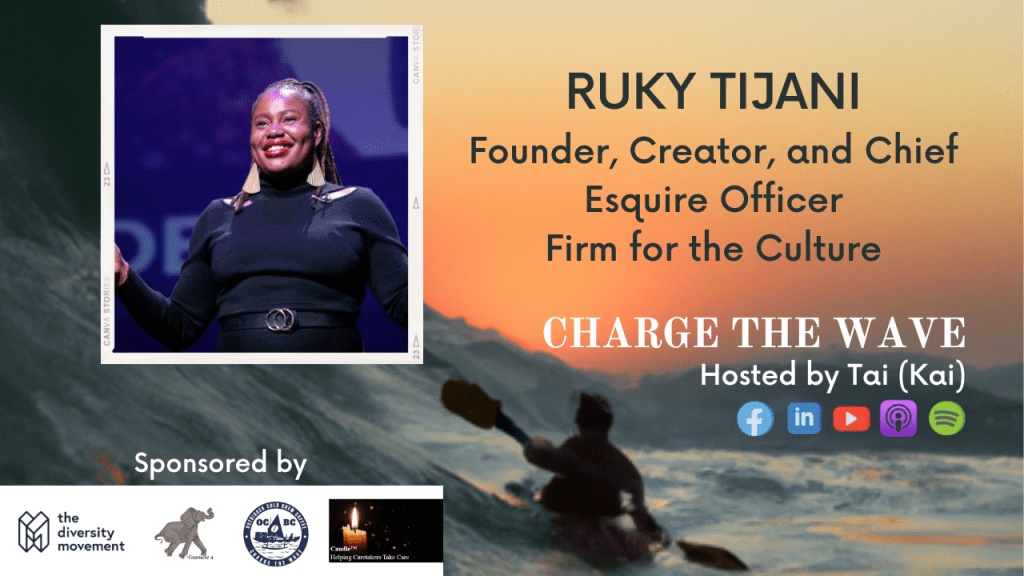
In this episode of Charge the Wave, we welcome guest Attorney Rukayatu “Ruky” Tijani, the Founder, Creator, and Chief Esquire Officer of Firm for the Culture.
Ruky founded the Firm for the Culture after years of serving as an intellectual property attorney in the Silicon Valley Office of the top litigation firm in the country. Firm for the Culture was borne out of Ruky’s passion for the law, social impact, social entrepreneurship, and strategically scaling to create sustainable change.
Tune in to this episode as Ruky talks about:
- Her upbringing from the projects of Brooklyn, NY to where where she’s at right now
- Why she started Firm for the Culture
- Her progress in making a social impact
- Advice for people who are looking to change careers
- Her message to the tech community that have been laid off
About Attorney Rukayatu “Ruky” Tijani
Rukayatu “Ruky” Tijani is the Founder, Creator, and Chief Esquire Officer of Firm for the Culture.
Ruky founded the Firm for the Culture after years of serving as an intellectual property attorney in the Silicon Valley Office of the top litigation firm in the country. Firm for the Culture was borne out of Ruky’s passion for the law, social impact, social entrepreneurship, and strategically scaling to create sustainable change.
As a Social Entrepreneur herself, Ruky knows what it’s like to seek social change while learning to protect a business’s assets. And her mission is to help Social Entrepreneurs Trademark their Brands as they Scale their Impact™.
Drawing on her extensive experience as an intellectual property attorney in the Silicon Valley office of the top litigation firm in the Country, Ruky provides extensive, detail-oriented and comprehensive trademark education, strategy, and application services to a host of social entrepreneurs and innovative founders at accessible flat-fee prices.
In addition to serving as Managing Attorney for Firm for the Culture, Ruky is also the Founder and Creator of the First Generation Purpose Project ®(“FGPP”), an initiative designed to help First Generation Professionals and Entrepreneurs navigate life and career by utilizing the grit and tenacity that is already on the inside of them.
Ruky is a proud Nigerian-American first-generation professional from the projects of Brooklyn, New York; a graduate of UC Berkeley School of Law; and a member of the New York and California State Bars. She loves to cook, sing, and hike.
Learn more about Attorney Rukayatu “Ruky” Tijani:
Visit Ruky’s business website: https://firmfortheculture.com/
Connect with Ruky on LinkedIn: https://www.linkedin.com/in/rukayatutijani/
Follow Ruky on Instagram: https://www.instagram.com/firmfortheculture/
Email: Hello@firmfortheculture.com
Read the full transcript of this episode:
TAI ( 00:02:24): Today our guest is Rukayatu Tijani. Ruky and I served on the pipeline to practice board together several years ago, and I also interviewed her for Above the Law in January 2020. She’s the Founder, Creator and Chief Esquire Officer of Firm For The Culture. She founded Firm For The Culture after years of serving as an IP attorney in the Silicon Valley Office of Quinn Emanuel, one of the top litigation firms in the country. Firm For The Culture was born out of Ruky’s passion for the law, social impact, social entrepreneurship, and strategically scaling to create sustainable change. Ruky is a proud Nigerian-American first generation professional from the projects of Brooklyn New York, a graduate of UC Berkeley School of Law and a member of the New York and California State Bars. Today, we’ll cover her upbringing from the projects of Brooklyn New York to where she’s at right now, why she started Firm For The Culture, her progress in making a social impact, advice for people who are looking to change careers and her message to the tech community that have recently been laid off. Without further ado, here’s today’s episode.
TAI ( 00:03:23): Congrats on all your success with Firm For The Culture thus far. But before we jump right in, do you want to do a quick intro and provide some background, Ruky?
RUKY ( 00:03:32): Yeah. So first of all, TaiI just want to start off by just saying, thank you so much for having me on this amazing and established platform. We’ve known each other for a little bit of time right now and it’s been dynamic to see your success in your own regard. So a little bit about me, I’m a first generation everything, from the projects of Brooklyn New York. After graduating from Berkeley UC, Berkeley School of Law, I went on and joined a lot of top law firms. And even though I engaged that journey, you know, in a way that was pretty uh pretty much set out for me, I wanted to quit, I wanted to quit and I wanted to quit because as a first generation everything I didn’t know what I didn’t know about navigating the space effectively. And that frankly, along with the abysmal lack of diversity made me want to quit. But I have friends and mentors and I, and a little sprinkling of divine intervention, that convinced me not to quit. So I ended up joining the number one litigation firm in the country as an IP attorney in the Silicon Valley. And I loved it. I loved engaging copyrights, trademarks, patents, trade secrets. I loved being with a lot of the burgeoning startups as well as the multibillion dollar unicorn companies. But I also wanted to make sure that I was utilizing my skill in a way that embraced uh all of our diverse contribution to the culture and really encouraged all inventors, all creators uh and, and folks who may not necessarily have a seat at the table to protect and monetize their brand and their creativity. So I decided to leave uh this fancy law firm and I started Firm For the Culture which really doubles as my love letter to culture and creativity and creatives. And it allows me to really utilize the skill sets that I’ve learned in a lot of these top places in a way that helps uh social entrepreneurs and diverse founders play big without breaking the bank.
TAI ( 00:05:54): Well, thank you for sharing that quite an impactful statement. And so interesting. Well, let’s jump right in. Uh, where did you grow up?
RUKY ( 00:06:04): So, I grew up in Brooklyn, New York,, and I think every time someone new meets me they’ll know that within the first 30 seconds because apparently us New Yorkers, especially Brooklynites will just say, oh, I’m from Brooklyn, I just need you to know that. So, it’s, it’s a, it’s a source of great pride.
TAI ( 00:06:21): What block exactly, let’s dig in.
RUKY ( 00:06:24): Well, my mama still lives there so I won’t be too, too specific, but I’ll talk, I’ll talk about the general neighborhood. So I grew up in Coney Island. I grew up in Coney Island in Brooklyn, New York. And oftentimes when people think of Coney Island, they think of the amusement rides, they think of cyclone baseball games. But there is very much a neighborhood behind all of the rides and the fanfare and it’s the neighborhood that I grew up in, the neighborhood that I went to school in, and it’s a neighborhood that I essentially had my coming of age in.
TAI ( 00:06:54): Yeah. Any siblings?
RUKY ( 00:06:56): Yeah. So, I’m actually the middle child of three. Um, I think a lot of people think that I am the oldest or the, uh, or, or the only child in, in some respects. But, um, I think that’s because of the three children my parents had, I was the only one born without developmental disabilities. So my younger brother has Down Syndrome and autism. My older brother had Down Syndrome. My older brother passed away when I was 15 years old and even before that, while my mother was going to school, um at night after work, I would take care of my brother. So I, I do believe that’s a part of the reason why oftentimes I’m assumed to be the oldest when I’m actually the middle child.
TAI ( 00:07:49): Gotcha. I’m sorry for hearing that. Any unique challenges or interesting experiences you care to share from, from your childhood. You mentioned a couple already.
RUKY ( 00:08:02): Yeah. Yeah, for sure. So, you know, as I noted taking care of my developmentally disabled brothers, but I think what compounded the impact of that was living in poverty, essentially, it was not uncommon for us uh to have more month than money or to figure out how we were going to pay our bills, pay the rent, pay for the next meal and also in living in the projects of Brooklyn, New York, you know, you see a lot of things there. Oftentimes it goes beyond the pee in the elevators and the needles on the staircase. It really goes beyond all of that to see friends that may not make it to their 21st birthday or to go to baby showers of like 14 or 15 year olds. But there’s a complexity you know, as much as my upbringing, um served as a source of a lot of trauma, it also served as a source of a lot of triumph and hustle and determination. Because it was also in the projects of Brooklyn, New York that I used to burrow myself away in like the bathroom or a closet to just study. So from that I understood and, and learned how to study even in the midst of calamity and chaos, it was in the projects of Brooklyn, New York that I knew, you don’t, you know, talk out of your… people in Brooklyn will understand this. You don’t talk out of the side of your neck to certain people. Like you pick your battles, you pick your battles. And it was through that experience that I learned how to, you know, really be discerning in big law and beyond as to what battles to pick and as to what, you know, um battles to ultimately hold on to ultimately win the war. So there were a lot of uh tried and true uh pieces of wisdom that I gained as a result of having navigated a space like uh the projects of Brooklyn, New York. And it’s something that I still proudly, many of the skill sets, including the ones I mentioned, are still proudly ones that I use to this day.
TAI ( 00:10:29): Any role models in particular that help you navigate these rough waters, um these choppy seas.
RUKY ( 00:10:37): Yeah, for sure. I’m loving the analogy of choppy and I see what you’re doing – charge the wave. Uh uh well, the person, the captain, like if we’re gonna still play that the captain that helped me navigate these, these, uh, rocky waves, um, was one of my high school teacher. Her name is Susana Giberga. And, you know, I went to high school in Brooklyn. I went to a kind of magnet high school of sorts and, um, while I did pretty well, um, or okay in high school, it wasn’t until I became her, Susana Giberga’s student, that I really realized, okay, I actually can do a lot more. And this is how I navigate how I do the more that I am intended to or purposed to. So Susana Giberga was the head of our school’s, We the People uh debate or, or um constitutional law team. And in that capacity, she trained us in the understanding of the founding of our country. So it was in her classes that we were trained on things like constitutional law, the Articles of Confederation, the, the Madison, you know, Federalist Papers, the anti Federalist papers uh and slavery all in hopes that we would compete with other schools in New York in particular, but also as part of a national competition to ultimately become the reigning champions of, of the We the People national competition. And I remember being in uh you know, her class and her telling me after, you know, me being a little lackadaisical, that was my senior year after all uh that I could do better and she would assign me things like reading the New York Times from cover to cover every single day and writing a summary, and actually printing out and reading the United States Constitution and actually understanding, you know, each of the uh sections of Article 1 Section 3, which is Congress’s power or the legislative branch’s power. And um from that, uh I was part of a team, an inner city high school team that ended up beating at the time, Stuyvesant High School, Half Hollow Hills High School, these very, very elite high schools in the competition and we ended up going to Washington, DC and being named the top 14 in the nation with knowledge of the Constitution. And that changed my life. It changed my life because it helped me understand that I could actually put the work in and I could succeed in ways that up until that point I didn’t really believe were possible.
TAI ( 00:13:55): That’s amazing. I mean, there’s, I’ve been, you know, right, not to digress too much in this intro segment, but I’ve been writing about law firms since 2014, it’s been. I’ve seen a lot of quite a few law firms come and go, a lot of different trends in the industry. And it’s been pretty incredible watching your, your voyage and that roots in your DNA of your persistence and the resilience the pattern throughout your life that you’ve talked about and highlighted here that’s, that’s incredible. Um How did you select your undergrad and your law school?
RUKY ( 00:14:30): Yeah. So I want to take that question into two because regarding undergrad, I don’t think I made that decision frankly. Uh, and I’m sure a lot of young students of color or first gen students can identify with this. Um, although I was a smart girl and am a smart girl, um, my counselors didn’t really encourage me to, to, uh to apply to like the NYU’s or the Columbia’s um or the Cornell’s of the day. And in fact, I remember a counselor said to me, you have two choices in HBCU or community college, which was crazy to me because I graduated high school with a 97 GPA. So I fell in, in essence to um the University at Albany, which was my undergrad, and I loved it. It was definitely a great experience, but I can’t help and I couldn’t help at the time but think what if somebody actually told me I could apply to the NYU’s and the Columbia’s of the day. And I think because I felt bamboozled out of that experience, I didn’t feel like I was really given a fair chance or was really given the adequate information to make an informed decision. I, I think that’s where a lot of my hustle and drive came from. I started doing and engaging a lot of independent research. So when uh it came from to law school um during my first year of undergrad, just undergrad, um a mentor took me to the Law School Admissions Council Fair and it was through that, that I saw school schools like Berkeley and Stanford and Columbia and Harvard and Yale and NYU in UCLA. I saw all of the college, I saw all of the law school um kind of advisors, you know, nicely standing behind their table and telling us what we needed to do. So, because I got that exposure, my first year of undergrad, I was really, really dogged um about making sure that I had the credentials to get into one of those schools. And in fact, I ended up graduating undergrad as the Valedictorian of both of my majors, Africana studies and um Political Science. I was the graduate speaker of my political science major. I graduated with a 3.99 GPA, graduated summa cum laude. Um I was the top 1%. So it was, I think there was definitely a dogged determination to not repeat the things that happened in undergrad. And as a result, you know, I was able to make a more informed decision. And I ultimately chose, after receiving countless acceptance letters to a lot of top 10 schools um and T 14 and T 20 schools, I ended up choosing Berkeley because of their um mission and their commitment to social impact and public interest, and because they were very explicit about embracing diversity. So that’s where I decided to spend the next few years of my legal education. And I think what’s so powerful is that the counselors didn’t stop discouraging me. But I was, I just happened to be more equipped. So, whereas um for my undergraduate decision, I didn’t know what I didn’t know and I didn’t know that I could go outside the counselor’s office to talk about my insecurities, to get access to resources to know, you know, what pre-undergraduate programs were available to really optimize my um college application process. And um when it came to law school, the counselor still said the same thing. They said, you know, you shouldn’t even think about applying to top 10 schools. You shouldn’t think about applying to any of these institutions. But I was equipped, having had gone, having gone through uh one of the top pre law programs in the country, the Trials Program, which is an initiative um and a collaborative effort between Harvard Law School and NYU Law School and the Advantage Testing Foundation and having met in my cohort, people from Yale undergrad, Berkeley undergrad, Harvard undergrad, having now, have had having now having friends at schools like Berkeley and Harvard and Yale and them telling me, no, actually you should apply to these schools. So it, having been equipped this time with information outside of my own insecurities because I still had them as well as counselors who with seemingly best intentions, I would believe they came with the best intentions were not gearing me towards my purpose. I ultimately decided to go to Berkeley Law School.
TAI ( 00:19:52): It’s powerful, powerful. Thank you for sharing that. The first segment is called, you know, building the ship. And this segment that we’re going to transition to is called sailing the ship. And I always like to kind of transition this segment with a shout out to Reid Hoffman in his book, The Start Up of You. He talks about treating your career as a living breathing, growing startup. Would love to hear a little bit about your career journey. Some, you know, stops along the way and how you got to where you are today.
RUKY ( 00:20:22): Absolutely. And I think a lot of just how I, how I learned to navigate my career really came in how I learned to navigate the law school application process now that I reflect on it. As I noted a couple of seconds ago, it was through the lack of information or the lack of access uh to meaningful gems of wisdom that I became really, really dogged in my approach. And I became really, really determined to find out the things that could get me to the places I wanted to go. And, you know, once I got to, you know, Berkeley, and once I got to a lot of the fancy law firms. I think I kind of sat down for a moment and I think I kind of sat back for a moment because I found myself as the only person who looked like me in these spaces. And I didn’t wanna, I don’t want to shake up the boat to give that analogy here. And as a result, you know, I let other people kind of lead, um, my career and take charge of my career. I wasn’t campaigning as much to get on cases. I wasn’t raising my hand to do the difficult matters. I, because I, I didn’t even know what a billable hour was, right? So because of that, I did find myself once again wanting to quit, wanting to leave the field not thinking I was good enough. And yeah, and as a result, you know, I, I almost did quit. But again, friends and mentors and a sprinkling of divine intervention made me realize that I had agency in my career and made me realize that if I wanted to experience more and optimize my career journey, I had to take responsibility for how I showed up. I had to do things like get career coaching, to learn how to navigate corporate America, to get therapy, to learn how to overcome much of the trauma that I grew up with. Um and to get mentorship so I could use my career as a platform for meaningful social change. And impact.
TAI ( 00:22:47): You certainly have been rocking the boat, I would say over the last several years, as you’ve been, you know, wayfinding and side winding to, uh, find your place in the market. Anything in particular about your formative years, your background, your years of big law that led you to starting Firm For The Culture.
RUKY ( 00:23:10): Yeah, for sure. So, as I noted, I’m from Brooklyn. So there’s definitely that hustle vibe like you don’t come from the same place where Jay Z and Biggie come from without really, you know, having that hustle mentality of sorts. So I remember in college, I used to make and sell jewelry. Uh and, and I remember just being so good at it that I ended up paying for a lot of my parents’ furniture in their house. And I also used to sing the national anthem um and the black national anthem for money. And that ended up giving me the funds I needed to apply to law school and pay for my law school application. So there was definitely, I think in that a strong foundation of asking for and going after the things that I wanted. And then like, I noted that I’m also an avid researcher and one of the reasons why I love the law so much is that it really does award deep research and determined excavation. Um So the legal field is not one of those places where you can like kind of fake it till you make it, it’s a place where you got to roll up your sleeves and it’s a place where you gotta start uncovering things like case precedent, case rules, hornbooks, treatises. And, and while honestly, I wish I could burrow myself in a corner and simply engage in research, uh the hustle part of me, and the fact that I now have a team to lead, an impact to make really gets me up in the morning to, to ask for what it is that we need to continue making the impact that we need. And then my faith um I have a really, really strong foundation in my faith that I like to call myself a God girl um as a Christian. So even when it came to starting my entrepreneurship journey and starting Firm For the Culture, it was not something I had ever anticipated doing. But I do believe that it was something that I was kind of pushed to in essence or, or maybe uh graciously nudged towards uh to start because I knew that I wanted to make meaningful impact. And at the time, I didn’t know how I was gonna do it. And I remember just God like ordering my steps to get to what would ultimately become Firm For The Culture.
TAI ( 00:25:26): Well talk to me a little bit about that burning desire to found Firm For The Culture and what Firm For The Culture is about. Mission, vision, values.
RUKY ( 00:25:35): Yeah, for sure. So Firm For The Culture is a 100% virtual law firm designed to help social entrepreneurs and diverse founders trademark their brand, monetize their brand and scale their social impact. And it’s so interesting because I think this is a full circle moment Tai, because you’re one of my first interviews or you, you interviewed me when I launched Firm For The Culture. And one of the questions that you asked me is what is, what are one of the goals that you have for Firm For The Culture? And I remember just saying, I want to help um diverse founders play big and now to date, we have about 200 clients. Isn’t that crazy? And about a 95% success rate at the United States Patent and Trademark Office. And we’ve been able to successfully help um tons of clients monetize and protect their brands in all aspects of social impact, including, you know, protecting the rights of transgender and non binary youth in the juvenile justice system, helping increase diverse, diverse voter turnout in primary elections and encouraging women of color to be more ambitious without burning out. So, you know, thank you. I want to say thank you for helping me really um kind of ideate what it was that I wanted Firm For The Culture to achieve and thereby, you know, helping me create a like a zenith point of sorts to look to um to that ultimately got me to this place. So thank you.
TAI ( 00:27:17): Anything you wish when you began your startup, your entrepreneurship, your own law firm journey.
RUKY ( 00:27:27): Uh I think the thing that I wished for was community, uh in a lot of, in a lot of senses um because I was the middle child of two developmentally disabled brothers. You know, there, there were a lot of silent times, there were a lot of times where I didn’t feel like I could connect with my siblings on, you know, a personal uh level. And because I was also a bookworm, there were times where I didn’t feel like I could connect with my community in Brooklyn, New York. It wasn’t uncommon for people to say, oh, you talk white or you’re an oreo, what have you. Um And then you go to a place like big law and while you’re engaging some of the most brilliant people in the industry, it’s a very lonely place to be at times, you know, you are engaging hours upon hours of research in solitude. If you’re in big law, you rarely make it to the courtroom because you’re doing document review or brief writing or all of these other things that don’t really allow you to see the light of day. Uh And you know, insecurities are very, very much prevalent in, in, in big law as in corporate America, as in any place. So there’s definitely uh a little bit of kind of cutthroat-ness and, or just lack of meaningful friendships uh that can be pervasive in these spaces. So when I started Firm For The Culture, I was really looking for community. And I remember um one of the people that I ended up connecting with, her name is Ticora Davis, who still to this day stars as one of my closest friends and my mentor. Um she was really the catalyst to create a community. I remember for the first time seeing a bunch of black women attorneys who had, at that point started their own law firm and seeing a bunch of attorneys of color start their own law firm. And I remember just thinking, oh my gosh, I found my people, I found my people, I found people who get me. Um and, and going into entrepreneurship, honestly, Tai brought me into a space of a lot of collaborative attorneys that and in a way I had never seen before, like, it’s not uncommon for me to now reach out to an attorney and say, hey, you have expertise in copyright. My, you know, my niche is trademark, but I’d love to kind of ask you a question without, you know, without feeling like they’re gonna take my client or vice versa. And that was something that I was really intentional about. And that was something that I do really feel like I gained as a result of starting the law firm. And it’s something that I bring to the law firm. You know, my team is growing. Um We hired an attorney, we hired other team members to assist on the administrative tasks and were really intentional about creating community and sparking joy. And that I, I, I’m 100% certain that, that um intentionality towards kind of perpetuating that positive culture would not have been in place had I not started with a strong foundation of community when I first launched Firm For The Culture.
TAI ( 00:31:18): And I remember hearing this and I often repeated, it’s when you’re building a business or startup, you’re staring at the abyss chewing glass, getting donkey kicked in the stomach every day. And it’s really the binds, the relationships that you’re able to put together, that you’re able to create and foster that will get you through that chaos that you can be handed glove hand in hand with good teammates, with good colleagues, with good peers. Is there anything specifically that you look for when you’re hiring or building out your team in individuals?
RUKY ( 00:31:52): I love that. Um I look for a can do attitude, and I look for a figure it out attitude. Because we are a small but mighty team, every person’s contribution or lack of contribution makes a huge, huge, huge difference in the firm. And I and I would be remiss if I failed to mention I, I haven’t been, you know, I haven’t done it, right. I haven’t hired, right. You know, I’ve hired based on vibe, I’ve hired based on just the resume instead of really digging deep into whether this person was a good fit, not only culturally but like worth ethic wise. Um I, and I also had to get very, very clear on the type of leader that I am. Um One of the things and I and I kid I gotta say this in jest with a couple of my mentor slash law firm owner colleagues, um I have a very hard time being both a mentor and a boss and that was something I had to learn about myself. And what I mean by that is I very much am a mentor. I have mentors, you know, uh I have student mentors like at Berkeley, at Stanford, even at Harvard, like I, I mentor folks, but it’s very difficult for me to mentor you at the same time that I’m paying you because, because we’re so small and because there’s a level of need to know now that I need you to have. And if I’m kind of pouring into you, which I love to do, but also paying you and, and there’s a lot of, you know, uh there’s a huge learning curve that you’re, that you’re working to achieve, it gets a little hard to move meaningfully and efficiently towards progress in my experience. Uh So after, you know, a couple of bouts of, of, of hiring people who I ultimately ended up mentoring and still mentor to this day, I I started becoming more intentional about focusing on folks who had that requisite experience but who wanted change. So, uh the lawyer, for instance, that’s currently in my firm has over 20 years’ experience including working at the United States Patent and Trademark Office and in house at huge corporations and representing brands like Barbie and Hot Wheels and Fisher Price, and American Girl. And then the Social Media Manager that I have has had over eight years experience and then the Executive Assistant I have has had over eight years experience. So I do think that in that regard, there’s still a lot of great pouring into that I love to do. But it’s also with the knowledge that if I’m not available for a day or two things would still move as planned. So that’s essentially what I look for uh in short, you know, really great experience, really great can do attitude, but really strong work ethic.
TAI ( 00:35:03): And we’re gonna head to break in a minute but had two more questions before we took a break for the sponsors. The first is what would you consider success over the next year? For Firm For The Culture?
RUKY ( 00:35:15): Yeah. So I think that tripling our revenue because we did triple our team. So tripling our revenue is definitely gonna be a big one. Um and also uh really meaningfully moving towards becoming the go to law firm for all things, social impact and intellectual property. We take a really, really different approach to IP. Having, you know, having done several workshops that really kind of combine or fuse together culture and intellectual property. It’s not uncommon for us to do a workshop about like Meg Thee Stallion or Cardi B’s Okurrrr or Nipsey Hustle and, and the trademark implications of that or even, you know, as of the taping of this recording, Rihanna just, you know had a successful Super Bowl halftime show. And I and I recently shared on LinkedIn her biggest flex to me even more so than like, you know, um telling the world that she was pregnant again, was saying I’m still not coming out with an album. I think that’s so powerful. And I, and, and, and I remember when I shared that post also sharing, she can do that because her federally registered trademarks of Fenty and Rihanna and Fenty Kids are literally raking in millions of dollars per month. So billionaires can be that unbothered, right? So being able to, to share things like that or being able to even share things like Jay Z trademarking his stage name and it being owned by Shawn Corey Carter, you know, otherwise known as Jay Z and not by his record company is something that is very reflective of our deep rooted mission to make intellectual property education accessible and culturally uh culture centered.
TAI ( 00:37:28): Wow. Any um I want to throw in a plug before the break. Any speaking events you have coming up for the year as well.
RUKY ( 00:37:39): Yeah, I do. I have a lot of them, but one of the ones that I always get really excited about is speaking with the American Bar Association Tech Show. It’s my third year or fourth year. I can’t… pandemic has got me like a little foggy with the memories. Um It’s my third or fourth year in which I’ve had the privilege of doing this. And um specifically, we’re gonna talk about how we leverage um culture to create meaningful social impact in the legal field. And I, I’m so excited to go to Chicago and to speak live at the ABA Tech Show.
TAI ( 00:38:18): Great. And with that, we’ll take a quick break for sponsors and we’ll return to close out the show.
VOICEOVER ( 00:36:51): Charge the Wave is brought to you by The Diversity Movement. The Diversity Movement DEI Navigator is everything you need all in one place. You get access to a host of resources with DEI Navigator and all at a fraction of the cost of hiring a full service DEI consultancy. Visit www.thediversitymovement.com/footnote to learn more. Outrigger Cold Brew Coffee Co. Be wherever you may and whatever your next challenge. Outrigger Cold Brew Coffee company is cold brewing our next batch of Aloha spirit from soil to sip to help you charge the wave.
TAI ( 00:39:12): Okay. Now we’re gonna hit the advice segment. One piece of advice for attorneys thinking of leaving big law.
RUKY ( 00:39:22): Oh, wow. I think one piece of advice that I can, I put it in two parts. Can I say we’re such lawyers? Were such lawyers? I’m like, can I do like one A and one B, um, so one A is that there’s often a false dichotomy in the legal field, especially when you, um, just have learned to be really, really successful and, and, and are curious and smart, but I do believe that there’s a false dichotomy in the legal field that we need to really start to address if people are going to make meaningful contributions to the legal field. And that false dichotomy is between, you know, doing corporate or big law work and being rich or getting the money and um not having, and then if you decide to leave that space, not having any other option but doing poor or, you know, uh good work or, you know, uh the work that Jesus would do, right. And I think often times because that false dichotomy is perpetuated the moment that somebody says I’m leaving big law. It’s like, well, how are you going to pay your bills? Like, what does this mean? What does this mean? And um I’m here to say, you know, as a person who left the number one litigation firm in the country, um as an IP attorney in the Silicon Valley to start my own law firm. And as a person who purchased my first house as a full time entrepreneur, uh that dichotomy is very much a myth and you can make meaningful impact, you can make meaningful contributions to the legal field without going broke and without feeling like you have to, and I’m not, no, no knock, no knock to non profit work. In fact, you know, uh much of the work that nonprofit organizations do is the reason why we’re able to as BIPOC and other and other, you know, dynamic uh intersectional identity, identifying people we’re able to navigate the spaces that we navigate. But what I am saying is it’s not, you know, all or nothing. You’re not just, you’re not making all the money in big law and then going broke and nonprofit. There’s definitely a middle ground and there’s definitely a way to create meaningful social impact while you are engaging uh the payment of your bills. And then, and then I think one B would be uh you are not starting from scratch when you’re leaving big law. One of the biggest things that I really had to wrestle with uh was this narrative that I was telling myself, which was I’m starting from the beginning and my therapist really helped me unpack that uh because I remember just feeling like I’m gonna lose all my contacts in big law, I’m gonna lose all of my connections in big law, I’m gonna lose the elite, you know, the elite title that comes with saying, oh, I’m from XYZ law firm and I’m gonna lose a lot of the prestige that comes with leaving big law. But what I’ve gained and what I could take with me includes the knowledge that I’ve learned navigating big law, the degrees or the accolades that I’ve gotten as a result of big law. Like, I still have my passage of the California and New York bar exams. Right. I can take with me the many meaningful relationships that I’ve established in big law and I can take with me the wisdom and the lessons that I’ve learned in terms of leading others uh in the legal field. And in fact, to this day, a lot of my friends and colleagues from big law use me as a resource to receive clients that otherwise would love to work with them, but may not have the financial resources to do so. So I think between those two, um, you know, the dichotomy between rich big law and poor nonprofit law, that’s a myth, and two, you’re not starting from scratch when you’re leaving big law. Um, I think anyone leaving big lawl is going to be well off or better off than I was.
TAI ( 00:44:01): And, and because our audience isn’t just attorneys and law students to be sure, just taking it up a plane when we’re thinking about, you know, working outside the A-frame for anyone who is feeling stuck. We’re just looking for new opportunities. Do you have any general career advice for someone who’s just feeling in a rut or maybe who just got laid off?
RUKY ( 00:44:26): Absolutely. And I love that you mentioned that because, um, because as an attorney who worked, uh, in the Silicon Valley, I’ve made a lot of friends in tech and a lot of them are, you know, have been laid off and I’m sharing this with you on the, on the hip, on the heels, of having just sent a voice note to a friend just saying, keep on going. I’ll introduce you to this person. I will make sure like I review your resume, I’ll make sure that I’m a listening ear when you need me. Um So I want to just like talk to the tech specific people for a second and then I’ll like go back to the more general information. I know that this is a hard journey. I know that this is a difficult season. Um You being let go is not a rebuke of your character, is not a rebuke of your ability to get the job done. Um I do think that, you know, from outside looking in so, you know, I’m part of my, my business is ministry so tell me when it’s time to mind my business. But from the outside looking in, I do think that we’re in a bit of a revelation of sorts. I do think that we’re in a bit of a renaissance. People are realizing that the way we work isn’t working, and people are really starting to reevaluate whether the leaders that are leading our tech companies, most of whom, you know, frankly just don’t have the EQ to, to, to lead like empathetically and authentically. A lot of us are looking at our leaders and wondering, do I trust you? Do I trust you with my career? Do I trust you with my family? Do I trust you with my purpose? So I do think that, you know, even as a leader of a quote unquote, non tech, but tech, you know, tech center, like I use a lot of technology in my firm as a, as a, as a non techie leader. Um talking to a lot of my clients who are technical founders and technical leaders. I do believe that there is a renaissance in what empathetic and intentional leadership looks like because it shouldn’t be the case that, you know, 11,000 folks are just let go from an email and, and are notified through an email at three o’clock in the morning and there’s no news that the Founder of said organization is not going to take a pay cut to save just a few more uh workers. There shouldn’t be, it shouldn’t be the case that uh you know, the responsibility or the onus falls on people who happen to come across a friend’s LinkedIn. You know LinkedIn comments or LinkedIn post to find, you know, now we’re now we’re helping to find a job and not to say that, you know, we’re not gonna gladly take on that burden for the sake of our friends, but the fact that we are the ones taking on the burden because there is no other way is inherently problematic. So again, I think we are definitely well positioned to look at how we are working and to have a better way of moving forward. Now, regarding those who feel stuck or seeking new opportunities, I think a few pragmatic things are helpful. I’m a pragmatic person. So I’m not gonna say reach for the stars, keep on going. Like we’re not doing that here. Get a career coach. Um Getting a career coach was one of the best investments that I made. And if you uh I believe that Korn Ferry, that’s the career coaching program that I use. Korn Ferry spelled K O R N F E R R Y. Um they provide career coaching and it’s a little less than I think $100 and $50 a month. So it’s definitely um more financially accessible than many people anticipate. And it was through me having a career coach in my transition from big law to full time entrepreneurship that I was able to just be able to hit the ground running to take therapy. Therapy is not for crazy people. Therapy is not for troubled people, therapy is for people. Um There’s gonna be a lot of narratives and triggers that you are learning to overcome when you are stuck or when you are let go of a job or when you are making a huge transition in life and having a qualified therapist with you to unpack, you know, what is coming up on your journey and how you navigate effectively the parts of your journey that are a little bit more tumultuous than others. Um It’s definitely going to be important to keep you going. And then three hang out with friends who affirm you, especially in dark times. Again, one of the things I’m doing with my dear friend is just affirming her. I think she’s one of the most brilliant people that I know who happens to have been at a tech company that let go of her and thousands of other team members. So being able to just affirm her uh and make her feel like she still has a place in the world is definitely something that um I feel privileged to do. But I also lean back into uh in terms of receiving affirmation from friends, if and when needed.
TAI ( 00:50:02): What wave will you charge next? In other words, what’s next for Firm For The Culture and yourself?
RUKY ( 00:50:11): Yeah. Um Immediately I want to have a and it sounds very small and tripe, but I want to have a retreat with my team. I think as 100% virtual law firm we work with folks literally from all around the world. And we’ve been, we’ve always been remote. So many of my team members I’ve actually never met in real life. So being able to just hug them consented, of course, because, you know, in California, labor and employment laws are real but being able to hug them and being able to, you know, break bread with them and connect with them and hear their story is definitely a huge next step for Firm For The Culture. Because at Firm For The Culture, we’re very intentional about bringing joy to the workplace. Um So I do think that being able to do that um in a, in a very connected way, away from a lot of the cases, away from all of the calls and emails, what have you, it’s going to be awesome. And then long term, we want to be the go to intellectual property firm for all things social impact. If you’re thinking about playing big, if you’re thinking about making a meaningful change, if you’re thinking about increasing diversity in STEM education, increasing diversity in tech or breaking down barriers to entry uh for in the fashion company or anything else of meaningful social impact. And uh you want to make sure that your IP is protected. We want to be the first firm that’s top of mind uh in all aspects of your intellectual property. So that’s, that’s what’s next for us.
TAI ( 00:51:52): Great. And with that we’ll move to the coffee buzz round or the final moment of the show. My favorite caffeine is Outrigger Cold Brew. I’m biased of course. And that’s one of our sponsors. Do you have a favorite caffeine? A choice or morning? Wow.
RUKY ( 00:52:07): Well, I definitely gotta try Outrigger. It sounds yummy. A Starbucks Pike Place is definitely my coffee of choice. I’m a relative purist. Um, I’ve never really been the one to go for all the fancy drinks. It’s like just give me a black coffee with some cream and sugar and I’m a happy camper.
TAI ( 00:52:28): Any uh, favorite local restaurants?
RUKY ( 00:52:31): Oh, wow. Um, I don’t know if I have a favorite local restaurant. Well, actually I’m lying. Um, I love hole in the wall, Nigerian spots. I love hole in the wall tacos. I love hole in the wall spots. Like I just love being able to get something really, really authentic. And oftentimes, you know, we, people never really remember the name of the restaurant, we just remember the vibe. Remember the fact that it’s like really, really hipster. Remember the fact that uh you can just get a bunch of food for not too much money. So I would say, um, hole in the wall spots. My favorite types are Nigerian hole in the wall spots which are like, amazing and Mexican hole in the wall spots.
TAI ( 00:53:19): Any favorite hobbies or anything you do to increase your energy and mental health runway.
RUKY ( 00:53:25): Yeah. So I’m really into audio books right now, like really, really heavy and um I’m rereading a book called The Breakup Bootcamp: The Art and Science Behind Breaking Up. And um you know, while I think, uh and the reason I’m reading is because I just happened to come across it in my recommended books and was like, that sounds like an interesting book. But it’s really, really powerful and it’s helping me understand my different attachment styles. It’s helping me understand why I get triggered and why I respond to certain things and it’s helping me overcome them in really, really meaningful and pragmatic way. So I’m really, really into audio books right now. And I’m also into this like tech app that is just changing my life. It’s called Groove and it is virtual coworking, essentially re imagined. What we do is we meet up to three other folks from all around the world literally. And we engage in 50 minute Pomodoro sessions where in each session we talk about things that we’re going to get done and we do them. And today I’ve done about 1000 Grooves and it’s been, yeah. And I’m actually having a, you asked me about my upcoming events. I’m actually having a LinkedIn Live uh soon with the Founder of Groove because I just think they’ve done an amazing and splendid job in designing tech for meaningful connection and community. I think they’ve done an amazing job.
TAI ( 00:55:03): Favorite musical? Show? Sports team?
RUKY ( 00:55:07): My favorite show is The Office. Like I am actually one of those folks that have, that has watched The Office, the entire series, three times. It is insanity. I just know that every time I come back it’s going to be the place that I can get laughs. I can, I can, like, there’s, there’s not a time where I think, oh, I don’t know what to expect from here. It’s like, I know that, you know, Michael Scott is gonna say something absolutely inappropriate. Right. Um, Dwight is going to do something absolutely inappropriate, you know, and, uh, just the characters are going to be like a rag tag, just dynamic team of folks, uh, who just make me laugh. So I, I just, I love that show. I really, really love that show.
TAI ( 00:55:57): Cree, Jim, Pam Andy. I love exactly, it’s amazing.
RUKY ( 00:56:03): Like Jim and I’m just going to keep the tension running for as long as possible, even though Pam knows she’s in love with Jim. But, you know, let me not stir the tea right now.
TAI ( 00:56:14): Uh, favorite vacation spot.
RUKY ( 00:56:17): I love New Orleans for a few reasons. I love the, the diversity of, of the, uh, the state of the city. I love feeling like I’m in another country when I’m in New Orleans. Um, and, you know, you can never go wrong with some beignets.
TAI ( 00:56:38): I’m going there in March. I’m looking forward to it.
RUKY ( 00:56:41): Vacation, personal, business?
TAI ( 00:56:43): Uh, my wife is a first grade teacher. So it is her spring break. We’ll get away for the weekend. Always a little business but mainly tourist.
RUKY ( 00:56:53): So, oh my gosh, really great places. Please let me know if you want any recommendations. I have a list.
TAI ( 00:56:58): Definitely, definitely dream concert.
RUKY ( 00:57:04): Oh, wow. Um I’ve noticed, okay, let me just start off by saying, and this is not to be rebellious. Uh And the reason I’m saying this because I literally like, I love the Beyonce Renaissance album. I love it. Like I’ve listened to it well, over 50 times now, I don’t feel like going to the concert and not because I don’t think the world of Beyonce because I do. But because I just don’t wanna be around 50 million people and I don’t want to like drive in slowly and I don’t want to drive out slowly. I just want to be at home listening to the album. Uh But if there was one person whose concert I would absolutely go to. Um if I could Whitney Houston, like I love that woman. Like I actually did cry. I know exactly where I was when she died and I actually did cry a lot when she passed away. So Whitney Houston, I think if I had one more moment with her, like another opportunity to dance with somebody, no pun intended, I would go to her concert,
TAI ( 00:58:07): My favorite wedding song. Dog or cat?
RUKY ( 00:58:10): Dog all day. And then big dogs. Little dogs? They, they, they be out here having a whole attitude sometimes.
TAI ( 00:58:19): So I think you just heard my Labrador retriever in the back.
RUKY ( 00:58:23): I love it. I love it.
TAI ( 00:58:25): it. Um If you could put any advice on a billboard outside any law school or university, what would you put on that billboard?
RUKY ( 00:58:35): Uh, keep going. God is working.
TAI ( 00:58:40): Any other life models or slogans.
RUKY ( 00:58:45): Um, honestly, and I know it sounds very cliche, but it really is keep going. God is working. I think that one of the things that has uh made has brought me to this point is not giving up, but in reevaluating over and over and over and over again, whether the way I’m working is working. Um I really do think that it was divine intervention when I wanted to quit the legal field several times and having people encourage me to look at what in the legal field it was that made me want to quit and not simply just take my uh decision at face value. It was when I realized that, you know, I couldn’t speak to diverse entrepreneurs without charging, you know, things like $700 an hour or I couldn’t uh access uh a lot of dynamic founders who were playing big because I was in this space that was inaccessible um or just the way that legal services were administered, it’s very technophobic. Um So when I realized that it was not necessarily the law that I didn’t like, it was the way legal services were given that I decided to make a change and that’s what’s kept me going. So I think just if there’s anything that I can share, it’s keep going, but also keep evaluating and reevaluating and keep on asking yourself is the way this is working. Is that working? Because I think it’s in that space of reevaluation that you actually can come out with ways that change the status quo as we know it in very beneficial ways.
TAI ( 01:00:46): Anything next on your bucket list that you’d like to check off.
RUKY ( 01:00:51): TED talk. Yeah, that’s the first thing that comes to mind. A TED talk. Uh I’ve learned a lot and, and being a law firm founder, I’ve learned a lot in speaking to thousands of folks who are seeking to play big with intellectual property. I’ve learned a lot of lessons as a leader. So I do think that a TED talk about how we utilize tech to provide access to justice is gonna really help my community and gonna help make meaningful change in the world.
TAI ( 01:01:30): Any parting words, you’d like to share with our audience before we close out the show.
RUKY ( 01:01:36): I’d be remiss if I didn’t shout out my firm Firm For The Culture. We’re a virtual law firm for social entrepreneurs and diverse founders. If you have a brand that you want to trademark, you know, go to firmfortheculture.com and sign up, and sign up for either a discovery call, on our contact page. You can find me at Rukayata Tijani on LinkedIn and all other social platforms. But yeah, like we have a really, really amazing team and we do really, really great work. So uh yeah, those are my parting words.
TAI ( 01:02:07): Well, thank you Rukayata Tijani for sharing your story with us. We look forward to following your successes. Until next time y’all, charge the wave.
VOICEOVER ( 01:02:03): Thank you for tuning in to another episode of Charge the Wave focused on entrepreneurs, executives and icons who are assiduously building companies, cultures and communities. Til next time, Charge the Wave. Charge The Wave is brought to you by Footnote 4. Footnote 4 has had a front row seat to many recent successes in the last several years, both advising and consulting for incredible individuals and teams who have risen above their stations by building high performance crews and cultures and carving their own paths throughout various industries along the way. Footnote 4 dedicates Charge the Wave to the late Duke Kahanamoku from 1890 to 1968. The greatest waterman pioneer and American icon of our time. The Diversity Movement. The Diversity Movement’s DEI navigator is everything you need, all in one place. You get access to a host of resources with DEI Navigator and all at a fraction of the cost of hiring a full service DEI consultancy visit www.thediversitymovement.com/footnote to learn more. Candle Cares. Candle Cares is an online tool that helps caretakers take care. Nowadays, caregiving has become a full time job for one’s parents, children, fur babies and ohana. Candle Cares helps you manage your caregiver crew, loved ones who need care and everyday tasks. A single candle can light many other candles without losing its own light. Candle Cares helps you be the light for others every night and helps your caregiving team organize their tasks on a daily basis. Coming soon to Apple and Android. Outrigger Cold Brew Coffee Co. Outrigger Cold Brew Coffee Co is cold brewing the Aloha spirit from soil to sip, waking up the wayfarers with its signature Hawaiian blends of coffee beans and roasting styles, including 100% kona coffee. As Mark Twain famously proclaimed in his letter from Hawaii, kona coffee has a richer flavor than any other, be it grown where it may and call it by what name you please. Be wherever you may and whatever your next challenge we’re cold brewing our next batch of aloha spirit from soil to sip to help you charge the wave.
About the Charge the Wave Podcast
Footnote 4 presents its Charge the Wave podcast – focused on entrepreneurs, executives, and icons who are assiduously building companies, cultures, and communities.
Charge the Wave aims to uncover the personal stories and anecdotes from inspiring builders and trailblazers in their respective professions and dig into the formative moments, hard-fought lessons, and circuitous voyages that are woven into the fabric of the everyday, interesting journeys of our fellow wayfarers.
Charge the Wave is focused on the industrious pioneers who are navigating the choppy waters of the unknown, rising and grinding everyday to face the endless uphill climb.
Charge the Wave is singularly focused on:
Inspiring entrepreneurs — who are building startups, battling the unstable seas to discover product-market fit, and aiming to launch innovative products and services to successfully cross the chasm into successful commercialization.
Influential executives — who’ve had winding career paths, weathered the storms and wreckages, and built resilient and high-performing crews and organizations.
Iconic individuals — who are becoming authors of their destinies and master navigators by wayfinding, sidewinding, wandering, and perfecting their craft, charting new courses to make an indelible mark in the world.
***
Footnote 4 has had a front-row seat to many recent successes in the last several years, both advising and consulting for incredible individuals and teams who have risen above their stations, by building high-performance crews and cultures — and carving their own paths throughout various industries along the way. Footnote 4 dedicates Charge the Wave to the late Duke Kahanamoku (1890-1968), the greatest waterman, pioneer, and American icon of our time.
Website: https://footnote4.com/
 Charge the Wave