Watch on Youtube: https://www.youtube.com/@chargethewave
Follow & Subscribe to Charge the Wave: Spotify, Apple
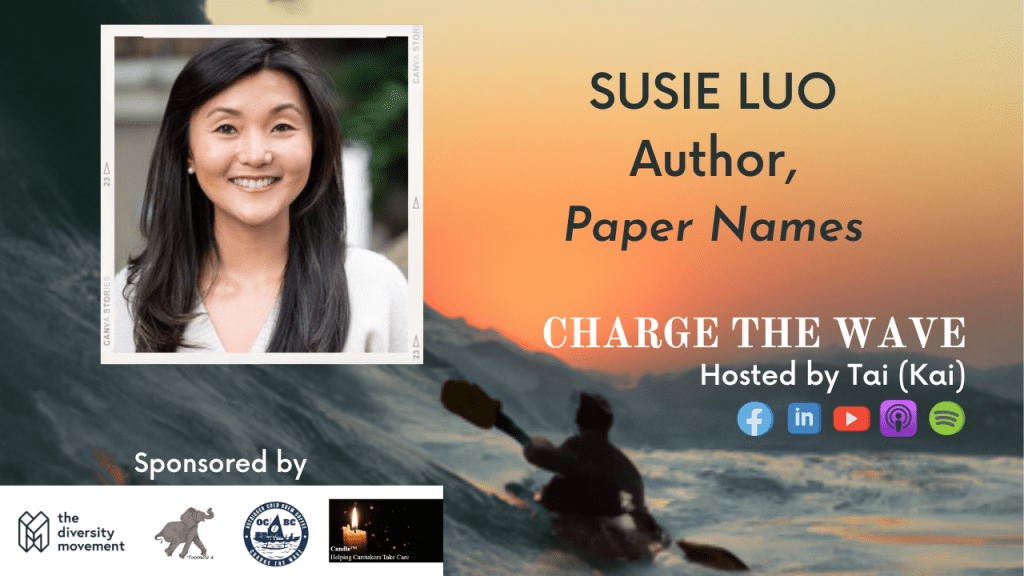
In this episode of Charge the Wave, we welcome guest Susie Luo, a writer based in New York. HarperCollins just published her first book, Paper Names.
Paper Names is A Book of the Month Selection for May 2023 || A Reader’s Digest Best Book of 2023 || An Amazon Editor’s Pick || A Publishers Lunch Buzz Book
Tune in to this episode as Susie shares insights into:
- Learning English and growing up in Flushing, NY
- How she came to publish her first book, Paper Names
- Advice for those thinking of leaving the law field
- Advice for those writing a novel
- How exercise has helped her manage her mental health
About Susie Luo
Susie Luo is a writer based in New York. She graduated from the University of Pennsylvania and Cornell Law School. She started her career as an M&A associate at Shearman & Sterling, and then worked as an investment banker at Goldman Sachs. HarperCollins just published her first book, Paper Names.
Learn more about Susie Luo:
Visit Susie’s website: https://www.susieluo.com/
Read the full transcript of this episode:
TAI ( 00:02:35): And we are going to plunge right in as mentioned today. Our first guest is Susie Luo. Congrats on publishing your first book, Paper Names, as of May 1st, May 2nd. But before we get into that, which we will, would love to just start on how it all began. Where did you grow up? And how would you describe it?
SUSIE ( 00:02:58): So first off, I just wanted to say thank you so much for having me on your podcast. This is very exciting. So I was born in China, and I immigrated to the States with my parents when I was three. We lived in Flushing for a few years, so that’s a really pivotal few years in my childhood, and I write about that in Paper Names. And then we moved to New Jersey and we bounced around different towns in New Jersey and that’s really where I grew up.
TAI ( 00:03:29): Great, great. Anything in particular you’re fond of?
SUSIE ( 00:03:34): In Flushing? Yeah, I just felt like when I was a child, you know, I was like 3 to 6, I think in Flushing and everything just felt like an adventure, you know, like going to the food stalls, like going to my parents everywhere because we didn’t have a babysitter. So I would go with my mom to the bakery she worked at, you know, I would like, walk with my dad to the grocery store that he was bagging groceries at like, but I didn’t feel that we were poor. I just felt like this was all new and fun. And I really missed that time when things were really simple.
TAI ( 00:04:08): Yeah. Yeah. Can you describe a unique or interesting challenge or experience from your childhood?
SUSIE ( 00:04:16): So I remember that the hardest thing for me when I was a kid in Flushing was learning English, because none of the grown ups around me knew English, right? My parents didn’t know it. My uncle, my aunt, my grandma, so I really had to learn it from just absorbing it in the world. And in pre-K I was teased a lot because I didn’t know the language and I remember there was going to be a spelling bee and I just thought I have to win the spelling bee so that like, they’ll just won’t tease me. So I studied a lot and then I remember just thinking, oh, the last word is going to be something really hard. So I just have to memorize a really good one. So I just decided to memorize elephant, and it was the winning word. And I, that was just the first time I felt like, oh, the universe has my back. You know, it was a really special moment for me.
TAI ( 00:05:05): Wow. Any role models or mentors, you’d like to give a shout out to?
SUSIE ( 00:05:11): My high school guidance counselor, Mr. Keo was just the best, most supportive person for me during that time in my life. You know, I went to a school where not a lot of people went to Ivy League colleges and he knew my dream school was Penn and he always believed in me. So, you know, shout out to Mr Keo.
TAI ( 00:05:33): Yeah. Why, why was that your dream school? How did you end up choosing Penn? And then Cornell for law school?
SUSIE ( 00:05:40): I wish I had a better answer for Penn, but I was really looking for a school that was both academically rigorous but also a party school. And that, at that time, that was Penn’s brand. And I was like, this is just where I wanna go. I wanna study hard, but I want to enjoy myself. I felt like, you know, high school was so stressful. I just wanted to soak in my time in college. Law school was a little different because I knew I wanted to be a lawyer since I was in middle school. So law school just felt like the next step. And Cornell gave me a nice little scholarship, and they had a small class size. So that’s where I went.
TAI ( 00:06:20): Any regrets from your college days or anything you wish you could do over?
SUSIE ( 00:06:27): No, I really lived out in college. I just had the best time. I think knowing that I was going to law school really helps because I feel like I didn’t have the same pressure that my other friends were interviewing, you know, banks or consulting firms had, they really had to make the choice about where they were going in their career right away. And at such a young age, and I was just like, well, I’m going to law school, so I’m just gonna have fun now because I know law school is gonna be hard.
TAI ( 00:06:57): I mentioned this book in basically every podcast, but Reid Hoffman has a book called The Startup Of You. And it’s about treating your career like a living, breathing, growing startup. And when I look at your career trajectory or your voyage, it certainly feels like you’ve treated it that way. I would love to hear how you thought about your career, when you started and maybe some stops along the way to where you are now.
SUSIE ( 00:07:22): I, to be honest, when I first started at the law firm as a first year, I was just like, I’m gonna stay here and become a partner and be here forever. And I actually had the same thought when I joined Goldman too, I was like, I’m just gonna stay here and become a partner and, you know, that’s gonna be my life. So, now I try not to make any definitive statements about my career because I’ve been wrong, you know, every time. I think the way I look at my career now is, I just want to follow my curiosity because that is just usually the place I put in the most time and effort and I naturally want to do the best job at.
TAI ( 00:08:03): Yeah. Could you pull the thread a little bit more on three years as an M&A attorney and then three years in IB or investment banking at Goldman. Could you describe a little bit about each of those experiences?
SUSIE ( 00:08:18): Yeah, of course. So Sherman and Sterling was my first job, right? And I stayed there for three years. And I worked on really interesting deals. But what I really took away from that experience is just a group of best friends. You know, you’re in the corporate trenches together, you’re taking care of each other and they’re still my best friends to this day. And I’m, well, I’ll be forever grateful to that firm for that. Goldman was probably the best corporate job I could have ever had. You know, the way I actually got it is by searching the word creative in the career website and my job popped up. It was the first posting under that search and I just had such a good time. I got to talk about future technologies, like virtual reality, bank of the future, and smart cities. And I got to talk about it with corporate clients and private equity folks. And it was just a fun thought experiment. You know, it’s a lot of storytelling in that job and I think that’s probably why I was drawn to it.
TAI ( 00:9:19): I think in our first communication, you mentioned Helen Wan and you mentioned Gold House. Did anything about The Partner Track resonate with you? And is there anything you’re working with Gold House on today that you’re allowed to discuss?
SUSIE ( 00:9:34): So I, I loved The Partner Track and I love the Netflix show. It was funny because my friends who are not lawyers would send me clips of The Partner Track, you know, and they’d be like, was this your life? You know, like, and I was like, no, I did not live on Central Park West and, you know, I did not have that wardrobe, but I just thought it was such a great show and really highlighted some of the problems that are at law firms and I feel like it did it in a way where it was entertaining to consume. And I think that’s really how environments and things change because like, people will watch it for fun and then it seeps into their head and they just, you know, subconsciously begin to act differently. Gold House is such a great organization and actually just had a call with their head of book clubs yesterday. So we will see, you could check out their socials to see what our collaborations are. But yeah, they’re a great community.
TAI ( 00:10:36): How did your formative years and background lead you to becoming an author, a writer and writing Paper Names?
SUSIE ( 00:10:47): So I wasn’t the kid who was, you know, three years old and was like, I’m just going to be a writer. I feel like a lot of authors have that dream when they’re young. But I did spend a lot of my youth in the library. My parents were vigilant about driving me there every week and, you know, getting a stack of books out and they’d be like, are you done with the books and eventually I just started reading at such a quick pace. I think I literally read the entire children’s section of the library. And, even in middle school, sometimes I hang out in the library. I was just, like, very happy and comfortable in the library. I think I would have considered writing earlier as a career if it were an option. Yeah, it just wasn’t presented as an option for me and I didn’t know any writers, I didn’t know. Even when I was reading, I think I didn’t even think like, oh someone had to write this, you know, it wasn’t like I was just consuming the content. but because I was good at reading and writing, I think being a lawyer was the default. And so I went that route. But eventually I found my way here.
TAI ( 00:11:55): Can you tell us more about the book?
SUSIE ( 00:11:58): Yeah, of course. So Paper Names is a story about two families who start in different tracks of the American dream and they’re set on a collision course with each other. One family is a Chinese family that immigrates to the States and the other is a white wealthy family with a dark secret. a violent attack happens in the beginning of the novel that ties the two families together. And then we stay with the characters over the course of two to three decades as they make decisions that both reflect on who they are and who they want to be.
TAI ( 00:12:32): Is there anything that you believe will really resonate with the audience upon picking up the book or someone who’s just interested or curious, by the cover?
SUSIE ( 00:12:47): I hope that this resonates with anyone who picks it up because, well, a lot of the characters are Asian American and, you know, some are white, some, there’s all different races in the book. I feel like they all go on a universal journey of finding themselves, of finding their identity, right? That identity was a topic I think I thought of, about the whole time I was writing. You know, your identity is so complicated, so complex and it’s always in flux. And I feel like a lot of people consider facts like where you were born, what culture you were raised in, who your parents were, who your, what your family values are. They consider that to be part of your identity. But I actually consider that to just be your background. I feel like your identity is the choices you make, right? The decisions you make both because of and despite your background. So I think that’s just something everyone can relate to and each of these characters go on different journeys and you know, I hope one of them resonates.
TAI ( 00:13:53): Yeah, I love that description. Anything you wish you knew when you began, either on your career voyage or your writing journey?
SUSIE ( 00:14:03): I wish I just put less pressure on myself. I think, you know, coming out of college and even different steps of my career, I felt like a lot of pressure to always make the perfect next step, to make the logical best, financially sound next step. And I just wish I knew it’s ok to make mistakes. You know, even when I wrote this novel, I sold it. After I sold it, I actually ended up rewriting 20 of the 28 chapters, like just deleting 20 of them. My agent and my editor were like, like, but I just knew that was the right choice and they gave me that space to do and they trusted me. And I think that’s something I learned a lot during my writing process. Like, just trust yourself because your instincts are telling you something for a reason and you just really have to listen.
TAI ( 00:15:02): In our earlier discussion, you mentioned, just making the leap from investment banking into what you’re doing. Now, was there anything dispositive of how you were able to make that jump, that leap of courage from IB to what you’re doing today?
SUSIE ( 00:15:21): So the, so making the leap from banking to writing only happened once Harper Collins bought my book, I feel like, you know, it just wasn’t financially feasible before then. It was a hard process because, you know, just like if you start a business writing is really, you know, my own business and you put in so much hard work in the beginning and the niggling thought at the back of your head is always, is this ever gonna be worth it? Like is this ever gonna come to fruition? Am I ever going to see rewards from this? Am I ever going to have to, am I ever gonna be able to stop grinding? And I think that was probably the hardest part of making the leap, juggling both banking and writing at the same time.
TAI ( 00:16:08): I read a tweet that said it’s not 10,000 hours, it’s 10,000 iterations. And you know. Yeah. And then I do very little writing compared to you and I just feel like it’s all about the edit, all about the iterations. A million cuts by the time we’re done, it could look totally different than where you started. And that’s part of the fun of starting with the blank canvas.
SUSIE ( 00:16:29): I think it’s a part of the pain as well, but, but like I think when you’re done with it, then you think it’s fun. I feel like I’ve probably blocked out a lot of the really painful parts of this process. But I am really grateful that I was able to stick with it. I think that’s the hardest part, right? Staying dedicated, staying committed. Even when you can’t see the light at the end of the tunnel.
TAI ( 00:16:56): Yeah. Finding beauty in the struggle. Certainly. Anything you would consider a success for you over the next year, 12 months?
SUSIE ( 00:17:09): I would love to finish my second book. I, you know, when I write, I just become obsessed with whatever new world I’m writing in and I’m on this, I have momentum now in the second book. So I feel like it’s always in my brain. I dream about it and I would love to finish it. And the other thing I really want to do is also soak in this experience of publishing my first book. You know, I feel like there’s so much anxiety in the build up to launch. And what I’ve heard from other authors is that you don’t want to lose this time to anxiety, to, you know, fear of just hoping things will be ok, just like take it a day at a time and just be happy for everything you get. And I really hope I can live that out.
TAI ( 00:18:02): And I’m obviously gonna push for your book’s option to get picked up. I would love to see it on the screen one day and I know you’re talking about that.
SUSIE ( 00:18:12): Yeah, it’s definitely in process. So hopefully, that would be amazing. I mean, I think that’s every author’s dream, right to see something you create, not just on a page but in a whole different medium and, and a different way that could connect with people.
TAI ( 00:18:29): Absolutely. And with that, we’ll take a beat for messages from our sponsor and we’ll return to close out the show
VOICEOVER ( 00:18:32): Charge the Wave is brought to you by The Diversity Movement. The Diversity Movement DEI Navigator is everything you need all in one place. You get access to a host of resources with DEI Navigator and all at a fraction of the cost of hiring a full service DEI consultancy. Visit www.thediversitymovement.com/footnote to learn more. Outrigger Cold Brew Coffee Co. Be wherever you may and whatever your next challenge is. Outrigger Cold Brew Coffee company is cold brewing our next batch of Aloha spirit from soil to sip to help you charge the wave.
TAI ( 00:19:22): Welcome back. Let’s plunge right to the advice segment and then we’ll go to our lightning round. Susie, is there one piece of advice you have for those starting on their career voyage or starting in their professional path?
SUSIE ( 00:19:39): I think I would give them the advice I wish I could give myself, which was, you know, you don’t have to worry about making the perfect first step. I think this idea of perfect is really what kind of breaks us and stresses us out and it’s not necessary. It’s ok to make mistakes. It’s ok to be wrong and sometimes making a wrong step is actually the right step to make.
TAI ( 00:20:06): Any advice for those thinking of leaving the law? Sometimes you get on that treadmill, it’s hard to step off or pivot to a different career path. But maybe even in investment banking or just generally?
SUSIE ( 00:20:22): I think, you know, I don’t have great advice for people leaving the law. I think being a lawyer is a great job. You know, I didn’t leave because I hated being a lawyer. I think it was, it was rewarding to think through problems. It was rewarding to interface with clients. And the paycheck is usually very nice and stable, which I am missing very much right now. I think the only advice I would give is sometimes if you aren’t sure if being a lawyer is your right path, you have to give yourself some space to step back. You know, I think the hardest thing about stepping back from especially big law is that you’re always grinding, you’re always running, you have no time to think, is this what I really want to do? So I think carving out that time for yourself is vital.
TAI ( 00:21:18): Any words of advice for someone wanting to or currently writing the next Great American novel?
SUSIE ( 00:21:27): So I only wrote one book so I feel like my life may not be the best, but something that helped me is just I wrote a lot, but I also sought out criticism. I think you have to get critiqued, especially if you’re, if you weren’t educated in this field, right? I didn’t get my MFA, I don’t think I took any creative writing classes in college. Writing is a craft, like of course, everyone can write but to write a story, there actually are tools you need to learn. And you need to explore different ways of storytelling. And I think being open to being criticized is the only way you can improve.
TAI ( 00:22:13): I speak with a lot of just executive entrepreneurs, you know, those who are, you know, following their passion, following their labors of love or just working really hard in their day to day. And I don’t think we talk about it enough publicly about mental health and energy. How do you manage your mental health and your energy runway when you’re grinding? Because I’m sure it’s not just chilling these days as a writer, I’m sure it’s just as much work as you were doing before. If not more.
SUSIE ( 00:22:44): I feel like mental health is more important to me now. Because before in a traditional job, I actually think I got a lot of support from going into the office, right? Like you would interface with people even like saying hi to security guard or knowing the cafeteria lady who always gives you extra chicken on your salad. Like these interactions are actually really important and they contribute to the fabric of our lives and they always give you, like, a little boost, right? Like you smile, things like that. And now as a writer, I’m alone a lot of the time, and so I have to really, be intentional about how I manage my mental and emotional health. One outlet I love is exercise. I, I, I’m sure that’s the one you’ve heard. a bunch I think dedicating an hour just to myself to push my body or to push my mind outside its normal limits. That’s just such a good way for me to re-center and just be present. I love doing yoga. I love going to Barry’s. I love running through central park with my dog. My dog is a part of my support system, you know, like when I get really anxious about something, I just look at her and she’s just chilling, you know, she like, has no worries like she’s just having a good time and I’m like, I need to be more like my dog. And I think also realizing you’re not alone, right? And having a group of friends or family that you can reach out to at any given moment. I think, feeling like you’re the only one feeling anxious or stressed that can only lead to a downward spiral, like having a community is so important.
TAI ( 00:24:35): I feel that my year, I’m the year of the dog and my element is water. So I’m a water dog and I feel like that’s my spirit animal and I’m the most happiest and in, in a flow state when I’m, you know, being like a dog and chilling. You, you mentioned the number of things on the next horizon for you. Is there any other wave you plan to charge next or anything else that you’re excited about that you haven’t mentioned already.
SUSIE ( 00:25:03): So I would love to have the opportunity to charge two other waves. The first is potentially writing a screenplay. I feel like writing for different mediums would really push me out of my comfort zone and teach me a lot. And that’s really what I always want to be doing right, growing and learning. And another thing I want to explore is teaching. So I already teach writing workshops, but I would love to teach in a more academic setting, you know. So like Columbia, NYU, you can call me.
TAI ( 00:25:36): Ok, Columbia and NYU, she is available. We’ll move right to the coffee and lightning round. Obviously, I’m a little bit biased, but my favorite caffeine or pick me up is Outrigger cold brew coffee. Do you have a favorite? Pick me up in the morning and your daily habits?
SUSIE ( 00:25:53): Right. Now I’m just with black coffee but I’ll have to try your cold brew.
TAI ( 00:25:57): Oh, yes, definitely. Any particular black coffee brand? Did you just grab what’s on the shelf?
SUSIE ( 00:26:05): Yeah. I think I have a Nespresso. I love the intense, dark ones. I just, I think to me it’s not even the taste of the coffee, to be honest, it’s just the ritual of having it and sitting down and, you know, reading some news or reading a book. It’s just like a cozy feeling.
TAI ( 00:26:25): Well, I definitely have my colleague send you some Outrigger cold brew coffee and I can’t wait to get your response. Any favorite local restaurants?
SUSIE ( 00:26:33): I love this place called Uva. It’s like a cozy Italian romantic restaurant. It’s got like brick walls, bookcases. It’s very reasonably priced. The ricotta gnocchi is out of this world. So when you get it, you’re welcome.
TAI ( 00:26:51): Favorite hobbies?
SUSIE ( 00:26:53): I just really love being in Central Park with my dog. The hard thing about being in a city, especially because I grew up in the suburbs. I just miss space. Right. But I live right next to the park and it’s been the best decision I’ve made so far in my life, I think. I could just like, escape there and I just feel like I’m almost in a different place.
TAI ( 00:27:20): Favorite sports team? And I love Yoku forest bathing. That probably feels like forest bathing. Any favorite sports teams. Or musicals or shows?
SUSIE ( 00:27:31): So I grew up watching the Yankees with my dad and a couple of years ago I got to take him to a Yankees game with really great seats and that was such a highlight for us. I loved the musical, Once. I don’t know if it’s still playing, but I’ve seen a lot of musicals and plays and, you know, if you turn the lights low, you put me in a comfortable seat and you sing to me, I’m just gonna fall asleep like you should take it as a compliment. Like I am, I am enjoying myself, but Once is probably the only play I didn’t fall asleep in. so I just, I love it so much.
TAI ( 00:28:9): Best vacation spot?
SUSIE ( 00:28:12): Depending on the vibe you’re going for, I would say Bali or Paris.
TAI ( 00:28:17): Oh wow. Dream concert?
SUSIE ( 00:28:22): So I actually listen to music a lot when I write. Because I find musicians to be so inspiring, you know, they tell a story and make you feel something intense with just very few words. And I would love to see Adele or Taylor Swift in concert and I, I would have loved to see The Beatles as well.
TAI ( 00:28:44): All those are so great. I’m a big Taylor Swift fan. Yeah, obviously as well as the Beatles and Adele but Taylor would be very high on my list.
SUSIE ( 00:28:55): I don’t know if we’ll ever get tickets to see her because it’s impossible right now.
TAI ( 00:28:59): Yeah, Ticketmaster is not helping. Dog or cat? I know you mentioned your dog.
SUSIE ( 00:29:06): Yeah, I love dogs but I’m not opposed to cats. I’m open to loving a cat. I just didn’t grow up with one.
TAI ( 00:29:14): Ok. And what was your dog’s name?
SUSIE ( 00:29:16): Her name is Delta, and I named her before the variant. But it was, it made for a very funny scene when we would go to the dog park after, you know, when the variant was rampant and I would just be calling her like “Delta”, and people would look at me. I’m like, no, no, no, it’s, it’s not what you think. It’s the name of the dog.
TAI ( 00:29:37). And how old is she? Did you mention what type?
SUSIE ( 00:29:41): She’s three years old. She’s a total mix. I think she’s like a pit and lab mix.
TAI ( 00:29:49): I got this question from Tim Ferris. It’s basically if you could put anything on a billboard outside the school or university. What, what would you like to write on that billboard?
SUSIE ( 00:30:00): I would write, want to write something I needed to hear, which is just, don’t worry, it’ll be ok. I feel like in college people, kids know to push themselves and they just don’t know when to some, some don’t know when to relax.
TAI ( 00:30:16): Any other life mottos or slogans?
SUSIE ( 00:30:21): One that just served me well is just trust your instincts. Sorry, I wish these are more profound or original.
TAI ( 00:30:30): No, I think they’re great. Anything else you would want to conquer next on your bucket list?
SUSIE ( 00:30:37): So, last summer I went paragliding in Switzerland and that was amazing. So I would love to get the courage to finally skydive. I don’t know if you’ve, if you’ve done that before.
TAI ( 00:30:49): I have not. I need the courage, I think.
SUSIE ( 00:30:53): I think just flying through the air and just feeling like nothing else exists but you and like this earth. that would just be such a memorable feeling. But yeah.
TAI ( 00:31:05): Before we exit stage left, do you have any parting or closing words for the audience?
SUSIE ( 00:31:12): I, I would just tell the audience, you know, wherever you are right now, you’re doing great. Just, you know, trust yourself, take it a day at a time and maybe one of these days you can pick up Paper Names at your local indie bookstore. But yeah, just be healthy and be well.
TAI ( 00:31:37): Well, thank you, Susie, for sharing your story with us. We look forward to following all your successes. Until next time y’all, charge the way.
VOICEOVER ( 00:31:51): Thank you for tuning in to another episode of Charge the Wave focused on entrepreneurs, executives and icons who are assiduously building companies, cultures and communities. Til next time, Charge the Wave. Charge The Wave is brought to you by Footnote 4. Footnote 4 has had a front row seat to many recent successes in the last several years, both advising and consulting for incredible individuals and teams who have risen above their stations by building high performance crews and cultures and carving their own paths throughout various industries along the way. Footnote 4 dedicates Charge the Wave to the late Duke Kahanamoku from 1890 to 1968. The greatest waterman pioneer and American icon of our time. The Diversity Movement. The Diversity Movement’s DEI navigator is everything you need, all in one place. You get access to a host of resources with DEI Navigator and all at a fraction of the cost of hiring a full service DEI consultancy visit www.thediversitymovement.com/footnote to learn more. Candle Cares. Candle Cares is an online tool that helps caretakers take care. Nowadays, caregiving has become a full time job for one’s parents, children, fur babies and ohana. Candle Cares helps you manage your caregiver crew, loved ones who need care and everyday tasks. A single candle can light many other candles without losing its own light. Candle Cares helps you be the light for others every night and helps your caregiving team organize their tasks on a daily basis. Coming soon to Apple and Android. Outrigger Cold Brew Coffee Co. Outrigger Cold Brew Coffee Co is cold brewing the Aloha spirit from soil to sip, waking up the wayfarers with its signature Hawaiian blends of coffee beans and roasting styles, including 100% kona coffee. As Mark Twain famously proclaimed in his letter from Hawaii, kona coffee has a richer flavor than any other, be it grown where it may and call it by what name you please. Be wherever you may and whatever your next challenge we’re cold brewing our next batch of aloha spirit from soil to sip to help you charge the wave.
About the Charge the Wave Podcast
Footnote 4 presents its Charge the Wave podcast – focused on entrepreneurs, executives, and icons who are assiduously building companies, cultures, and communities.
Charge the Wave aims to uncover the personal stories and anecdotes from inspiring builders and trailblazers in their respective professions and dig into the formative moments, hard-fought lessons, and circuitous voyages that are woven into the fabric of the everyday, interesting journeys of our fellow wayfarers.
Charge the Wave is focused on the industrious pioneers who are navigating the choppy waters of the unknown, rising and grinding everyday to face the endless uphill climb.
Charge the Wave is singularly focused on:
Inspiring entrepreneurs — who are building startups, battling the unstable seas to discover product-market fit, and aiming to launch innovative products and services to successfully cross the chasm into successful commercialization.
Influential executives — who’ve had winding career paths, weathered the storms and wreckages, and built resilient and high-performing crews and organizations.
Iconic individuals — who are becoming authors of their destinies and master navigators by wayfinding, sidewinding, wandering, and perfecting their craft, charting new courses to make an indelible mark in the world.
***
Footnote 4 has had a front-row seat to many recent successes in the last several years, both advising and consulting for incredible individuals and teams who have risen above their stations, by building high-performance crews and cultures — and carving their own paths throughout various industries along the way. Footnote 4 dedicates Charge the Wave to the late Duke Kahanamoku (1890-1968), the greatest waterman, pioneer, and American icon of our time.
Website: https://footnote4.com/
 Charge the Wave
Leave a comment